Radon Health Risks
Your House Invasion
One of the most frightening things about radon, the colorless and odorless gas that is a leading cause of lung cancer and other diseases, is its silence. Radon does not announce that it is in your home, and unless you have your home tested, you may never know that high levels of this dangerous substance are present.
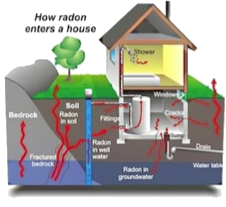
Radon enters your home in a number of different ways, so it is important to have your home tested and evaluated for radon levels, even if you do not suspect you have a problem. Radon is a naturally occurring substance, and unfortunately for homeowners it is found in virtually every part of the country. Radon is able to seep into your home through even the smallest cracks, and no home is airtight enough to prevent radon from coming in. Since the pressure in the interior of your home is lower than that of the soil surrounding your home, radon is able to seep into your home through the foundation. The foundation does not have to be cracked to allow radon to enter, although a crack in the basement wall or home foundation can certainly make the problem worse. Each building is unique, and the ground beneath it is also unique. Two houses side-by-side can have totally different radon levels.
Radon Through Basements
The difference in pressure alone can be all it takes for dangerous levels of radon to seep into your home. That difference in pressure acts like a vacuum, sucking the radon gas from the surrounding soil and environment into the interior of your home. Radon typically enters your home through the basement, then seeps up into the living space, putting yourself, your home and your family at risk.
Radon Info Links
 |
Radon information and publications from the U.S. EPA |
 |
AccuStar Labs has provided accurate, easy-to-use radon testing products since 1984. Their products and laboratories are NEHA and NRSB certified, and licensed in all States that have such requirements. |
 |
The NEHA National Radon Proficiency Program provides names of certified radon testing professionals, mitigators, and laboratories by state. |
 |
The American Association of Radon Scientists and Technologists (AARST), the radon industry’s professional organization, provides radon information and links. |
 |
The National Cancer Institute provides a fact sheet on radon and lung cancer as well as links to scientific studies. |
 |
Radon Leaders Saving Lives is an organization that was created by a coalition that includes the Conference of Radiation Control Program Directors, AARST, and EPA’s Radon program provides links to news, information, events and research studies about radon. |
 |
AARST and its American Radon Policy Coalition support this organization to "Provide a Voice to Stop the Nation's 2nd Leading Cause of Lung Cancer." The site offers information and first-person experiences. |
 |
The American Lung Association’s website provides information, fact sheets, and links relevant to radon and radon-induced lung cancer. Enter the site, then type “radon” in the Search option. |